
Helping others look like their best selves is rewarding work. If you live for those “Wow, I look good” reactions, turn your passion for beauty into a profitable business with education and state licensure. Here’s your path to a gorgeous career in cosmetology.
Quick Guide: How Do You Become a Cosmetologist?
- Confirm your state’s requirements
- Choose your training path
- Complete required training hours
- Apply for and pass your licensing exam
- Apply for your cosmetology license
Many cosmetology programs range between 1,200 and 1,800 hours, which often translates to about 1–2 years of full-time training.
What Is a Cosmetologist (and What Services Can You Legally Perform)?
A cosmetologist is a licensed professional who performs beauty services for hair, skin, and nails. You need a state-issued cosmetology license to legally offer services to clients. Your actual scope of practice depends on your state.
Here are some common services cosmetologists offer:
- Hair cutting and styling
- Hair color
- Skin care
- Hair removal
- Nail services
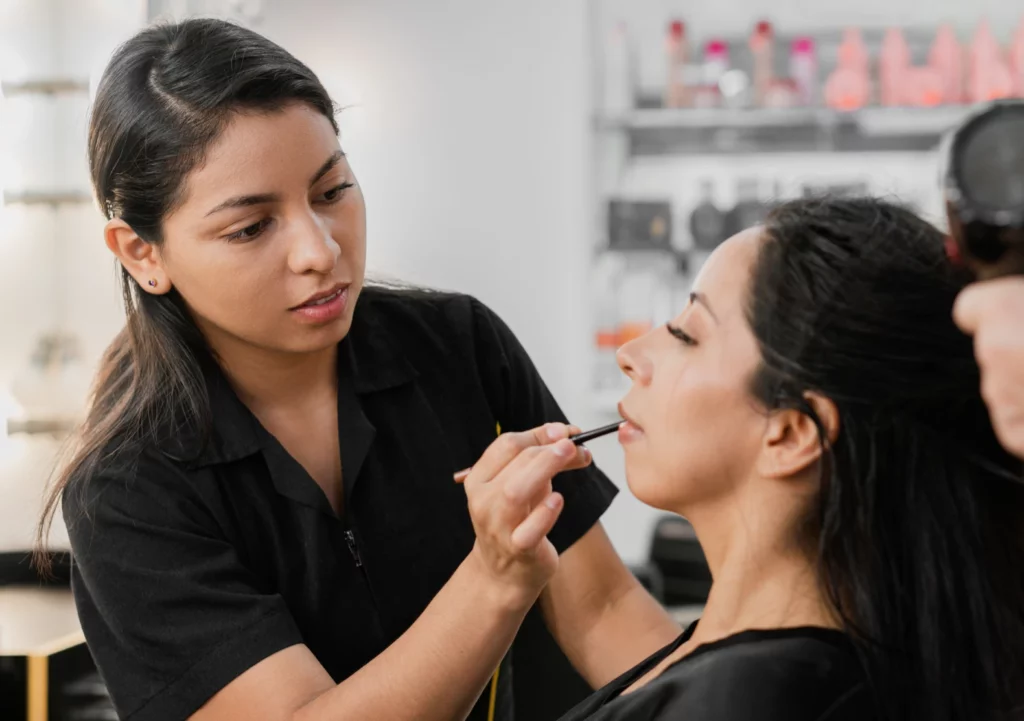
- Makeup application
Some states group hair styling, esthetics, nail services, and barbering together under a single license, while others have different requirements for each. Always verify what beauty services you can and can’t perform with your state licensing board.
TL;DR: If you enjoy providing cosmetic services, becoming a cosmetologist is a great career fit for you, but you do need a state license to do this work legally.
What Do You Need to Become a Cosmetologist?
To become a cosmetologist, you typically need:
- To be at least 16 years old (age requirement varies by state)
- A high school diploma or equivalent (like a GED)
- State board-approved cosmetology education
- Passing scores on the state licensing exam
- A valid cosmetology license
You also need to love bringing out the beauty in clients (if you’re reading this article, that’s a yes!), plus the physical capabilities and soft skills (like excellent communication) to do this work.
The specific requirements you must meet to become a cosmetologist depend on the state you plan to work in. Your state cosmetology board makes the rules about who can perform beauty services. This includes requirements on age, number of training hours, and more.

Step-by-Step: How to Become a Cosmetologist
Here’s a step-by-step guide to becoming a cosmetologist. Each phase gets you that much closer to your first client booking.
1. Confirm Your State’s Requirements
Start by visiting your state licensing board website to find your specific licensure requirements. These include:
- Age minimum (ranges from 16 to 18 years old)
- High school diploma or equivalent (GED)
- Number of education hours required
- Passing exam scores
- License application
Search “[your state] + board of cosmetology” to find the official website. They may also have a list of approved cosmetology schools to help you research a school that’s right for you.
✨Pro Tip
Find your state’s license guidelines (with links to official cosmetology board websites) and coverage requirements with our helpful directory: Beauty Insurance by State.
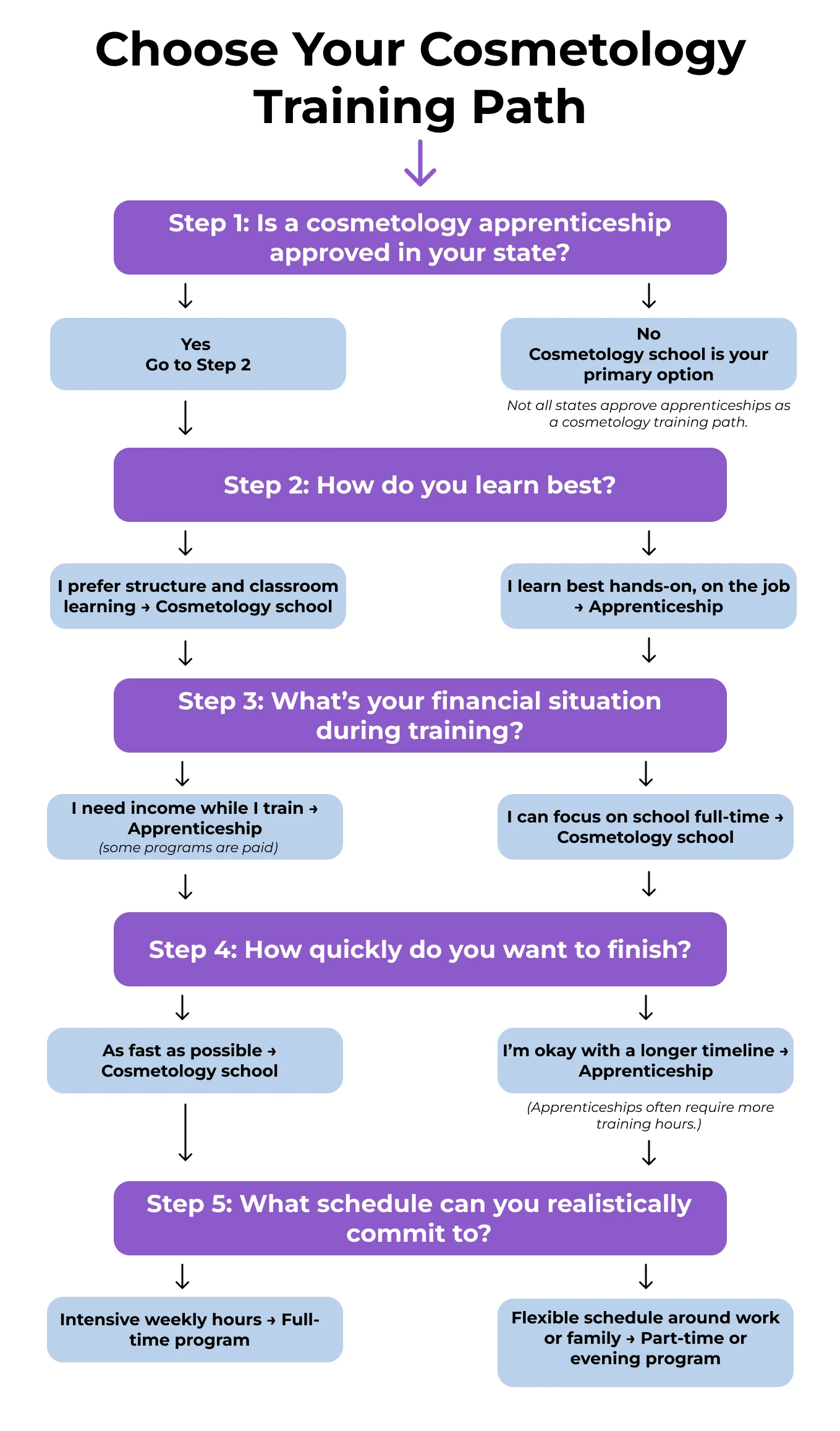
2. Choose Your Training Path
The next step is to choose your training path: either receive your education at an approved school or learn hands-on through an apprenticeship.
- At a cosmetology school, you receive a structured curriculum and practical training
- Through an apprenticeship, you earn hours in a licensed training salon, but the number of required hours is often higher (often twice as long)
Some apprenticeships pay you to learn on the job. However, some states don’t offer apprenticeships as an approved training path, so learning at a beauty school may be your only option.
You also need to choose a program type: part-time or full-time. The best choice for you depends on whether you can dedicate intense weekly hours to your education or if you need a flexible schedule to hold employment while you train.
- Full-time program: Shortest calendar time with a more condensed workload
- Part-time or evening program: Longer timeline with greater “real life” flexibility

3. Complete Required Training Hours
Next, enroll in cosmetology school and complete the required training hours. Your program length may align with your state’s minimum hour requirement, but it may also exceed it.
Cosmetology school will typically cover subjects like:
- How to perform hair services
- Skin, makeup, and nail service techniques
- Basic anatomy of hair, skin, and nails
- Sanitation and safety practices
- Chemistry of beauty products
- Business and professional skills
- State law basics (how to stay compliant)
Essentially, cosmetology school will teach you how to perform cosmetic services safely, plus additional topics like how to find work and build a client base.
Before you can receive your cosmetology license, you need to show that you’ve received the proper education and know what you’re doing, especially due to the hands-on nature of beauty services.
Most state boards require that proof of your completed education hours be submitted directly by your school’s administrative office.
4. Apply for and Pass Your Licensing Exam
After you graduate from cosmetology school, you can apply to take your state’s licensing exam. Many states choose the National Interstate Council of State Boards of Cosmetology (NIC) exam as their standardized exam.
Licensing exams for cosmetology have two parts:
- Written exam: Assesses your knowledge of cosmetology theory
- Practical exam: Demonstrate your technique in a hands-on setting while observed by an evaluator
Together, these exams demonstrate that you know your stuff AND that you can perform cosmetology services properly and safely.
5. Apply for Your Cosmetology License
Finally, submit your cosmetology license application to your state board. Many state boards of cosmetology offer online applications. Here’s what a typical application process looks like:
- Fill out the application
- Arrange for your official school transcripts to be sent to the board
- Ensure your exam scores are submitted to the board (usually automatically sent)
- Pay the application and licensing fee
Once you submit your application and all requirements have been met, your license will be approved!
Pro Tip:
Curious about how to promote yourself? Check out our guide: 7 Hair Stylist Marketing Strategies That Actually Grow Your Client List.

How Long Does It Take to Become a Cosmetologist?
How long it takes to become a cosmetologist depends on your state and your level of time commitment. Most states require 1,200 to 1,800 hours, which averages to at least one year if you go to school full-time.
The more time you can put into your education, the more quickly you can complete your hours. Your school may offer part-time (such as evening and weekends only) and fast-track options, so it really depends on what fits your lifestyle and goals.
How Much Do Cosmetologists Make?
Cosmetology salaries vary wildly, but the median pay of cosmetologists in the U.S. is $35,420 per year. Your actual earning potential depends on:
- Where you operate
- The specialty services you offer
- Your competition
- Your client base
Many cosmetologists find that once they build a loyal client base and niche, they’re able to confidently raise prices and grow their income.
How Much Does Cosmetology School Cost?
The cost of cosmetology school differs greatly across the U.S. On average, it ranges from $15,000 to $20,000 or higher. For example, Evergreen Beauty College in Washington state costs $19,690, and a Paul Mitchell cosmetology program in the same state costs $23,990.
The best way to determine your tuition costs is to compare your cosmetology school options directly. Keep in mind that some schools offer payment plans or financial aid via scholarships.
What to Do After You’re Licensed
Even after earning your license, you may not feel like a real cosmetologist until your booking calendar is full and you’ve got a steady stream of income. Here are some additional things to know for your post-licensure career.
Finding Your First Cosmetology Job
Finding a role that allows you to do what you love and grow at your own pace is key. Check out these common job paths for cosmetology.
Cosmetology Careers Compared
Swipe to view full chart
| Job Path | Best for | Things to Consider |
|---|---|---|
|
Salon employee |
New cosmetologists who want structure and mentorship
|
Less control over schedule and pricing
|
|
Assistant roles |
Cosmetologists focused on learning and skill-building |
Lower pay at first, but a strong experience foundation
|
|
Booth rental |
Cosmetologists with an existing client base |
You manage clients, pricing, and expenses |
|
Freelance, mobile, or events |
Cosmetologists who want flexibility and variety |
Requires self-marketing and organization |
Do Cosmetologists Need Insurance?
Yes, every cosmetologist needs insurance!
Cosmetology insurance is designed to protect your business against client-related claims, such as injuries or property damage. No matter how experienced or careful you are, you’re at risk of accidental chemical burns and client slip-and-falls, which can cost you big.
If you rent a booth, provide services at events, or work as an independent contractor, having the right coverage safeguards your work against expensive claims. In fact, many contracts require you to carry insurance before you can even set up your beauty chair!
Beauty & Bodywork Insurance (BBI) offers top-rated cosmetology insurance from $9.99/month, so you can help clients glow up with peace of mind.
FAQs About How to Become a Cosmetologist
Can You Become a Cosmetologist Online?
While there are some hybrid (online and in-person) cosmetology programs available, you cannot become a fully licensed cosmetologist 100% online. Learning how to perform beauty services requires hands-on training on top of any theory coursework you complete online.
What Education Do You Need to Become a Cosmetologist?
The education required to become a cosmetologist is typically a high school diploma or GED as a prerequisite, completion of a state board-approved cosmetology program, and passing scores on the state licensing exam.
Do You Need a License to Be a Cosmetologist?
Yes, you need a state cosmetology license to legally be considered a cosmetologist. If you offer cosmetic services without a license, you can be fined or face legal action.
Become a cosmetologist the right way by completing the required training hours and obtaining your license.
When Should a Cosmetologist Get Liability Insurance?
A cosmetologist should get liability insurance as soon as they start working with clients, even while in training. Liability insurance is designed to protect you if you accidentally injure or damage someone else’s property, which can happen to students or long-time pros alike.
Check out our Starter’s Guide to Cosmetology Insurance to learn more!